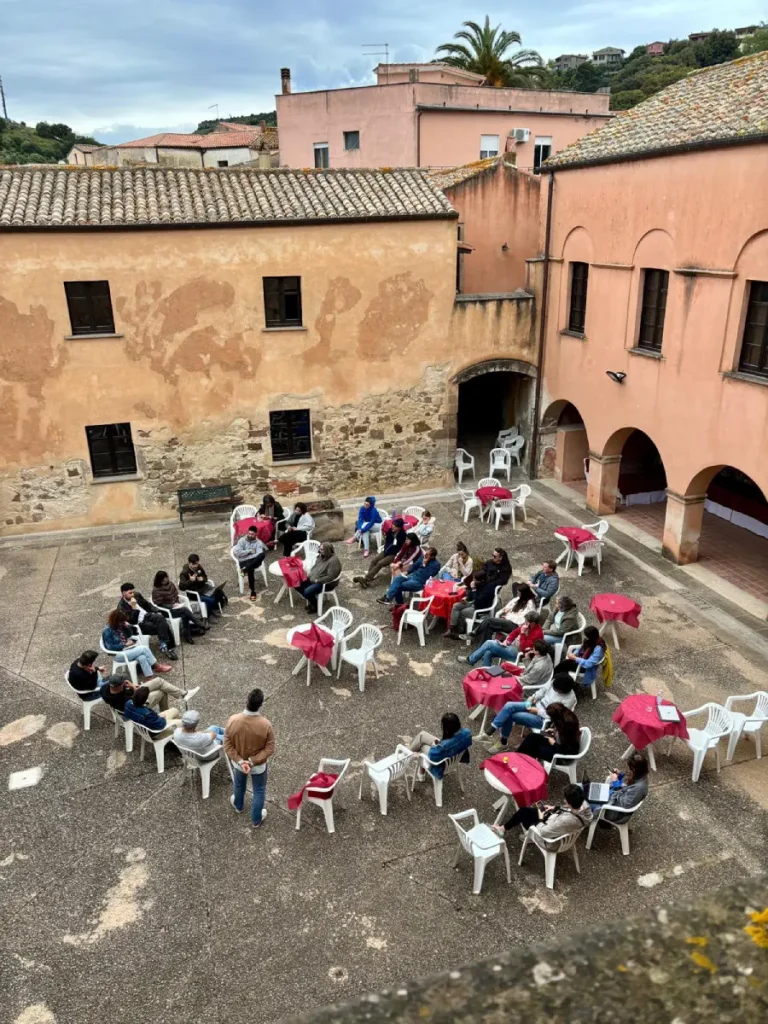
This May, we had the pleasure of taking part in the first CRAB (Creative Habitat) gathering, held in the heart of Sardinia. It brought together 20 rural hubs from across Europe—Portugal, Spain, Italy, France, Germany, Scotland, Denmark, Belgium, and others—who all share a common goal: building a community of rural creative spaces.
The idea behind the project is simple but powerful. By encouraging creativity and innovation in rural places, we hope to bring positive change to our local areas, support the people who live there, and help attract new residents who are excited to contribute.
Tertulia Coliving was grateful to be invited to this event and to meet so many inspiring people who are working in similar ways across different regions.
The gathering was hosted by Treballu, a rural coliving space in Laconi, a village in central Sardinia, that is doing a lot of job for revitalizing the local community. We stayed at Oasi Francescana, a special hostel adapted in a pilmgrims hosting place, and our meetings were held at the Museo dei Menhir, in a historic and beautiful villa that once belonged to the Aymerich family. Today it’s owned by the local administration and includes a magic 24-hectare park. It’s a real forest, with hundreds of different plants, hidden waterfalls, and paths winding through oak-covered hills.

Over two days, we joined a series of workshops and conversations. Thanks to the amazing job of the CRAB team we passed from planned sessions to spontaneous ones—during meals, walks, or in free time. People were genuinely curious and open, sharing ideas, stories, and experiences and there was a clear sense of being part of something bigger, even with all our different backgrounds and approaches.
We had a session about shared challenges and needs.One topic that came up often was how to truly engage local communities. Many of us attract international residents, which can sometimes create language barriers. We talked about ways to connect beyond words—through practical activities for example, or organizing events in public spaces where locals already gather more than just in our hubs.
Funding came up a lot. It’s not always easy to find the right financial support, so we explored ways to diversify our income, build trust with ethical banks, and think about long-term impact. Keeping our projects financially sustainable isn’t just a practical matter—it’s what allows us to stay and do meaningful work. If we can’t sustain ourselves, we can’t have an impact.
Another key topic was communication. Edo Sadikovic from Sende led a helpful session on how to tell people we exist, and how to stay visible to those who already support us. Sharing tips on how Sende communicates.
European networks like ECHN and Reset!, or institutions like Goethe Institut culure took part at the gathering, sharing their support for rural hubs and the work being done across different countries.
We shared also about Tertulia’s story that has been unfolding for nearly 20 years, well before the coliving project officially began. That long-term presence in a rural area has shown us how meaningful real continuity can be. Being rooted in one place allows relationships to grow naturally and trust to develop over time. The importance of being able to give continuity to our presence in the area is seen more clearly over the years, even if we started small and we faced many challenges. Staying in one place doesn’t mean standing still, of course. But it means also being part of the life of a place as it changes, and being there to grow with it.For that it’s so important a community of hub supporting each other and aligned on rural revival goals: it’s not just a slogan, it’s a life choice!
There was also an inspiring conversation about the role of art in rural life. Art can do much more than make things beautiful and stay in exibitions—it can get people involved and spark conversations around local issues. Claudia Zeiske, who’s spent over 20 years working on participatory art projects, put it simply: the village itself can be the venue. In places already rich in natural beauty, art becomes a way to activate and connect the community.
One important session brought together local Sardinian actors—hubs like Treballu, Aurora, Aggius, the Nodi network, and representatives from the regional government. We talked about what it would take to attract more people to rural areas, the role local initiatives play, and how public policy can support a shared vision.
The gathering ended with good food and a feeling of connection. We left with new ideas, new friends, and a strong sense of motivation. It was an experience full of learning, inspiration, and exchange—one of those rare moments where everything comes together and reminds us why we do what we do.
These kinds of events help us feel part of a larger movement. They give meaning to the everyday work of running a rural hub, facing challenges, and believing in something better.
And in the end, that’s what it’s all about—living in a way that feels hopeful, grounded, and connected.